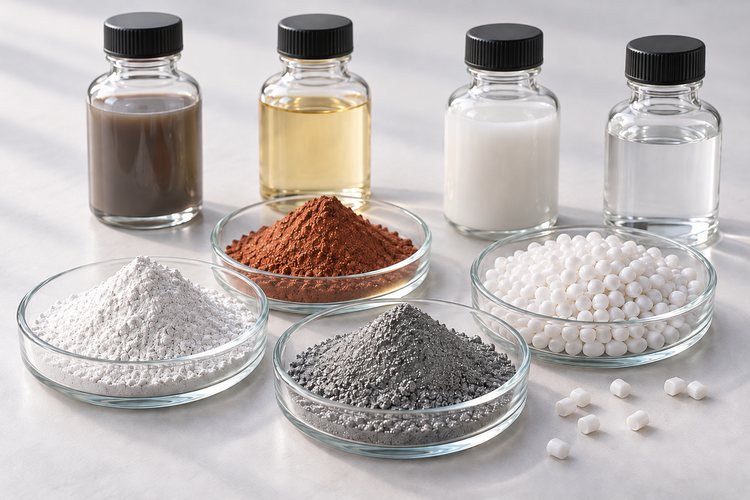
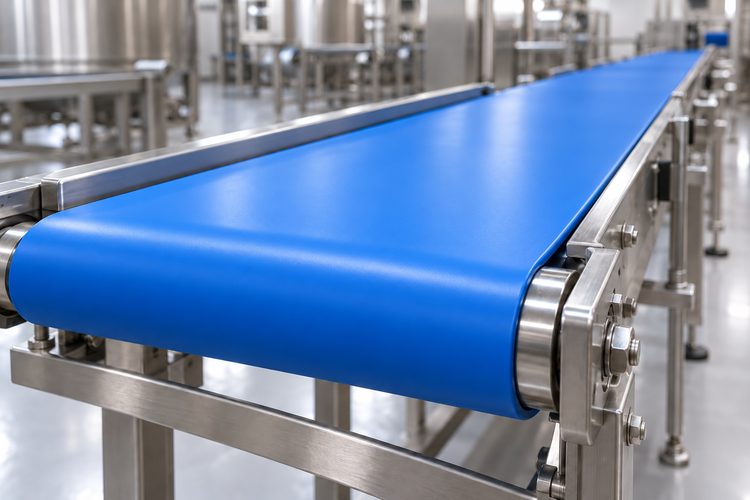
Thermoplastic polyurethane (TPU) is widely used in conveyor belting because it combines flexibility with good abrasion resistance, toughness and processability. In food, pharmaceutical and other contamination-sensitive industries, however, conventional TPU presents an additional challenge: fragments released through wear, damage or accidental cutting may be difficult to identify once they enter the product stream.
Metal detectable TPU and X-ray detectable TPU can reduce this risk by incorporating additives that allow fragments of the polymer to be identified by inspection equipment already used on many processing lines.
For belt manufacturers, however, adding a detectable filler is only part of the problem. A successful formulation must provide sufficient detection performance without unnecessarily compromising the characteristics that made TPU suitable for the belt in the first place.
Metal detection and X-ray detection are different
Metal detectors and X-ray inspection systems detect contamination using fundamentally different mechanisms.
A metal detector responds to the electromagnetic properties of a contaminant. A detectable TPU therefore needs to contain an additive system capable of producing a sufficiently strong response to the detector.
X-ray systems work differently. Detection depends primarily on differences in X-ray attenuation between the contaminant and the surrounding product. An X-ray detectable TPU therefore needs sufficient contrast relative to the food or other material being inspected.
This distinction is important because a TPU formulation that performs well on a metal detector will not necessarily provide equally strong X-ray visibility, and vice versa.
Where a conveyor belt needs to be identifiable by both systems, the formulation should therefore be developed and tested specifically for dual metal and X-ray detectability rather than assuming that performance in one system guarantees performance in the other.
Start with the TPU, not the detectable additive
For a belt manufacturer, the base TPU is normally already selected for good reasons.
These may include:
- hardness and flexibility;
- abrasion and wear resistance;
- tensile strength and elongation;
- tear resistance;
- resistance to oils, fats or cleaning chemicals;
- hydrolysis resistance;
- operating temperature;
- surface properties;
- weldability; and
- the requirements of the coating, extrusion or belt-manufacturing process.
The detectable system therefore needs to work with the selected TPU rather than forcing the manufacturer to accept an unsuitable polymer simply because it is available as a standard detectable grade.
Where appropriate, SCOPIC® technology can be formulated around a customer’s existing or preferred TPU grade. This can be particularly valuable where considerable development work has already gone into qualifying a belt material for a particular application.
Polyester or polyether TPU?
The underlying TPU chemistry can have a significant influence on belt performance.
Polyester TPUs are commonly selected for their mechanical strength, abrasion resistance and resistance to oils and greases. Polyether grades can offer advantages where hydrolysis resistance, microbial resistance or prolonged exposure to water is important.
The detectable additive system should therefore be regarded as an additional part of the formulation rather than as a replacement for correct TPU selection.
A formulation suitable for one conveyor application may not be appropriate for another, even where both require metal and X-ray detection.
Detectability versus mechanical performance
Increasing the concentration of a detectable filler will often increase the response from inspection equipment. It can also change the behaviour of the polymer.
Depending on the formulation, excessive filler loading can affect properties such as:
elongation, tensile strength, tear resistance, flexibility, abrasion resistance, hardness and processing behaviour.
This creates an important optimisation problem.
The objective should not simply be to incorporate the maximum possible concentration of detectable material. Instead, the formulation should provide sufficient and repeatable detectability at the lowest practical impact on the functional properties of the TPU.
This is one reason why formulation expertise is particularly important for conveyor belting. The material needs to be engineered as a complete compound rather than treated as conventional TPU with a detectable powder added to it.
Masterbatch or fully compounded detectable TPU?
Detectable TPU can potentially be supplied in two principal forms.
A detectable masterbatch allows the belt manufacturer to incorporate the technology into its own TPU during processing. This can provide flexibility and may allow an existing resin and manufacturing process to be retained.
A fully compounded detectable TPU provides a ready-to-process formulation in which the polymer, detectable system, colour and any other required additives have already been compounded together.
The best approach depends on the process and the degree of control required.
Masterbatch can be attractive where manufacturers already have well-established TPU processing expertise. Fully compounded materials may be preferable where tight control of additive distribution, physical properties or detection performance is required.
SCOPIC® can be developed in either form depending on the application.
Dispersion matters
Detectability does not depend only on the nominal percentage of additive incorporated into the TPU.
The detectable material also needs to be distributed consistently throughout the polymer. Poor dispersion can create local variations in performance and can also affect surface quality and mechanical properties.
Proper compounding is therefore important, particularly where low addition levels are being used or where the finished belt is relatively thin.
For this reason, development should consider both the formulation itself and how it behaves during actual processing.
Processing and weldability
A formulation that performs well as a laboratory test plaque is not automatically suitable for conveyor-belt production.
Manufacturers should consider how the detectable system affects:
- melt viscosity and flow;
- extrusion behaviour;
- coating or calendering;
- surface finish;
- adhesion between layers;
- heat or high-frequency welding, where applicable;
- dimensional stability; and
- processing temperatures.
Where welded joints, flights, cleats or profiles are required, the effect of the detectable formulation on the joining process can be particularly important.
Representative processing trials are therefore preferable to relying solely on theoretical compatibility.
Detection performance depends on the application
There is no single minimum fragment size that defines whether a TPU is “metal detectable” or “X-ray detectable”.
Actual performance can depend on numerous factors.
For metal detection these include the detector type, aperture size, operating frequency, sensitivity settings, product effect and the size, shape and orientation of the TPU fragment.
For X-ray systems, factors include fragment thickness, formulation density, X-ray energy, product depth, surrounding material and the configuration of the inspection system.
This means claims such as “detectable down to X mm” should only be interpreted in the context of the conditions under which that result was obtained.
A more useful approach is to test representative material using inspection equipment and conditions relevant to the intended application.
Testing the finished formulation
At Radical Materials, SCOPIC® formulations can be assessed using industrial metal detection and X-ray inspection equipment during development.
This makes it possible to compare:
- different detectable additive systems;
- different addition levels;
- alternative TPU grades;
- sample or fragment dimensions;
- formulation changes; and
- metal versus X-ray response.
Mechanical and material properties can then be considered alongside detection performance.
The aim is not simply to produce a TPU that triggers a detector. It is to develop a material that provides the required detection response while continuing to perform effectively as a conveyor-belt material.
Colour and visual detectability
Blue remains the most widely associated colour with detectable components used in food production because relatively few foods are naturally bright blue.
However, metal and X-ray detectability are independent of visual colour, and detectable TPU formulations can potentially be produced in other colours where required.
Colour should therefore be considered as a third layer of contamination control.
A belt or component can potentially provide:
visual detectability + metal detectability + X-ray detectability
within the same formulation.
The exact formulation needs to account for the pigments as well as the detectable additive system, particularly where light or unusual colours are required.
Food-contact requirements
Where detectable TPU will be used in food-processing equipment, regulatory suitability needs to be considered alongside mechanical and detection performance.
It is important to distinguish between the compliance of individual raw materials and the compliance of the final belt or finished article.
Factors such as the base TPU, detectable additive system, pigments, other additives, overall formulation and intended conditions of use may all be relevant.
For this reason, the required food-contact framework and end-use conditions should ideally be defined at the start of the development programme rather than treated as a final check after the formulation has been completed.
Additional functionality
Detectability does not necessarily need to be the only functional modification.
Where the application requires it, TPU formulations may also incorporate other functionality, potentially including:
- antimicrobial technology;
- antistatic properties;
- specific colours;
- UV stabilisation; or
- other application-specific additives.
Compatibility needs to be assessed carefully because one additive package can influence the performance of another.
Again, this favours a formulation-led approach rather than combining unrelated standard additives at arbitrary addition levels.
Development around the finished belt
For belt manufacturers, the most effective approach is usually to define the requirements of the finished product first.
These may include the TPU grade, hardness, belt construction, manufacturing process, mechanical targets, operating environment, required colour, regulatory requirements and the type of inspection equipment used by the end customer.
SCOPIC® formulations can then be developed around those requirements.
Radical Materials’ in-house formulation and compounding capability allows candidate materials to be produced in small quantities, processed into representative samples and evaluated before moving into commercial manufacture.
Where appropriate, development can also begin with the customer’s existing TPU, rather than requiring the manufacturer to redesign the belt around a predetermined detectable compound.
The key consideration: optimise the whole material
Metal and X-ray detectable TPU should not be regarded simply as conventional polyurethane with a detectable filler added.
For conveyor belting, the material still needs to function as a TPU: it must process correctly, provide the required flexibility and mechanical performance, withstand the intended environment and integrate with the manufacturer’s production process.
At the same time, it needs to provide meaningful detection performance using the inspection technology encountered in the finished application.
The best results therefore come from considering TPU selection, formulation, processing, mechanical properties and detectability together.
SCOPIC® metal and X-ray detectable TPU compounds and masterbatches can be developed specifically for conveyor belting and related flexible components, including formulations based around customer-specified TPU grades.